CycleWave BTC/USD H1# CycleWave BITSTAMP:BTCUSD H1 Time Reversal Prediction
## Technical Description
This indicator displays pre-calculated cycle data for Bitcoin on the H1 timeframe. Unlike traditional indicators that calculate cycles in real-time, this one uses carefully pre-analyzed cycle data that I manually input after conducting detailed spectral analysis offline. The indicator itself serves as a visualization tool that presents these pre-calculated cycles and provides statistical information about their performance.
## Core Features
* Displays a color-coded line representing manually identified market cycles
* Shows forward projection up to 32 hours ahead (dotted section)
* Uses color to indicate predicted trend direction (green = up, red = down)
* Includes an information panel with statistical data and timing estimates
* Pre-calculated specifically for BTC/USD on the H1 timeframe
## Data Source Methodology
The cycle data displayed by this indicator comes from:
1. Offline spectral analysis using specialized software
2. Manual identification of dominant market cycles
3. Careful filtering to select the most significant 4-6 cycles
4. Expert combination and weighting of cycles based on historical performance
5. Regular updates when market conditions change or cycles need recalibration
The indicator itself doesn't perform these calculations - it simply visualizes the pre-analyzed data and provides performance statistics.
## How To Use
1. The main colored line shows the projected cycle movement:
- Green sections indicate expected upward movement
- Red sections indicate expected downward movement
2. The dotted continuation shows the future projection
3. The information panel provides:
- Current trend direction
- Cycle completion percentage
- Hours until expected trend change
- Expected trend change timestamp
- Correlation quality (statistical measure of past accuracy)
## Practical Application
This indicator is particularly useful for:
* Timing entries and exits around predicted turning points
* Planning ahead for potential reversals
* Confirming signals from other technical indicators
* Understanding the current position within the cycle
## Customization Options
* Time Shift: Fine-tune the cycle alignment (+/- 24 hours)
* Invert Cycle: Reverse the cycle direction when needed
* Visualization settings: Adjust line width, dots width, and colors
* Information display: Toggle the statistical information panel
## Limitations
* Shows potential reversal TIMES, not exact price levels
* Periodically requires updates as market cycles evolve
* Performance may vary during highly volatile periods
* Past correlation does not guarantee future accuracy
The data behind this indicator is manually updated based on ongoing cycle analysis to maintain accuracy with changing market conditions.
Cari skrip untuk "Cycle"
Cycle Low (RSI + StochRSI) โ v5 John.KCycle Low (RSI + StochRSI) โ v5 John.K
This tool is designed to detect potential cycle lows by combining RSI and Stochastic RSI oversold signals.
RSI Oversold + Cross โ confirms momentum exhaustion
StochRSI Cross from Oversold โ confirms short-term cycle turn
Score System (0โ4) โ evaluates confluence strength
Strict Mode โ requires both RSI and StochRSI to be oversold for A+ signals
One-Bar Tolerance โ allows RSI & StochRSI to cross within 1 bar
Anchor Option โ optional reference level for cycle projection
Signals are plotted directly on the candles as green triangles (CL) when conditions are met.
Adjust thresholds (RSI, Stoch, Score) to control signal frequency.
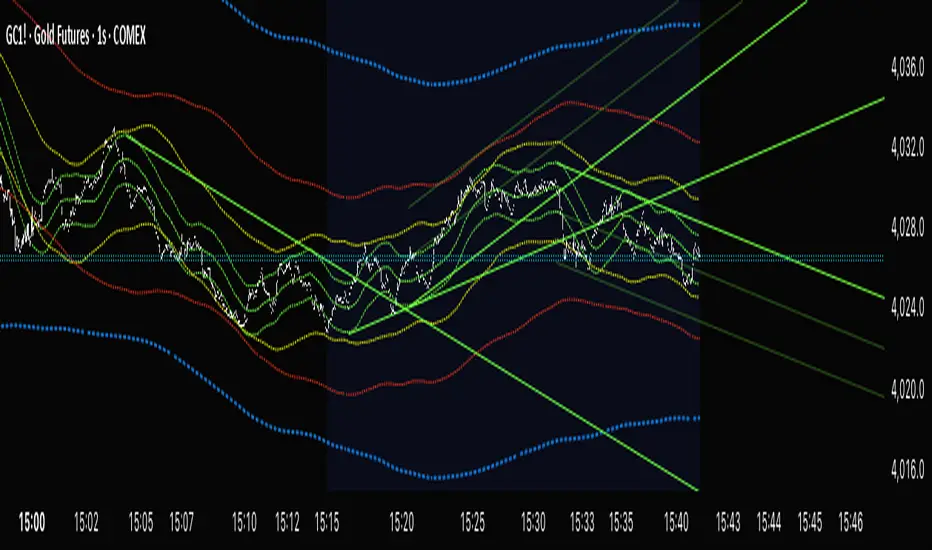
Cycle VTLs โ with Scaled Channels "Cycle VTLs โ with Scaled Channels" for TradingView plots Valid Trend Lines (VTLs) based on Hurst's Cyclic Theory, connecting consecutive price peaks (downward VTLs) or troughs (upward VTLs) for specific cycles. It uses up to eight Simple Moving Averages (SMAs) (default lengths: 25, 50, 100, 200, 400, 800, 1600, 1600 bars) with customizable envelope bands to detect pivots and draw VTLs, enhanced by optional parallel channels scaled to envelope widths.
Key Features:
Valid Trend Lines (VTLs):
Upward VTLs: Connect consecutive cycle troughs, sloping upward.
Downward VTLs: Connect consecutive cycle peaks, sloping downward.
Hurstโs Rules:
Connects consecutive cycle peaks/troughs.
Must not cross price between points.
Downward VTLs:
No longer-cycle trough between peaks.
Invalid if slope is incorrect (upward VTL not up, downward VTL not down).
Expired VTLs: Historical VTLs (crossed by price) from up to three prior cycle waves.
SMA Cycles:
Eight customizable SMAs with envelope bands (offset ร multiplier) for pivot detection.
Channels:
Optional parallel lines around VTLs, width set by channelFactor ร envelope half-width.
Pivot Detection:
Fractal-based (pivotPeriod) on envelopes or price (usePriceFallback).
Customization:
Toggle cycles, VTLs, and channels.
Adjust SMA lengths, offsets, colors, line styles, and widths.
Enable centered envelopes, slope filtering, and limit stored lines (maxStoredLines).
Usage in Hurstโs Cyclic TheoryAnalysis:
VTLs identify cycle trends; upward VTLs suggest bullish momentum, downward VTLs bearish.
Price crossing below an upward VTL confirms a peak in the next longer cycle; crossing above a downward VTL confirms a trough.
Trading:
Buy: Price bounces off upward VTL or breaks above downward VTL.
Sell: Price rejects downward VTL or breaks below upward VTL.
Use channels for support/resistance, breakouts, or stop-loss/take-profit levels.
Workflow:
Add indicator on TradingView.
Enable desired cycles (e.g., 50-bar, 1600-bar), adjust pivotPeriod, channelFactor, and showOnlyCorrectSlope.
Monitor VTL crossings and channels for trade signals.
NotesOptimized for performance with line limits.
Ideal for cycle-based trend analysis across markets (stocks, forex, crypto).
Debug labels show pivot counts and VTL status.
This indicator supports Hurstโs Cyclic Theory for trend identification and trading decisions with flexible, cycle-based VTLs and channels.
Use global variable to scale to chart. best results use factors of 2 and double. try 2, 4, 8, 16...128, 256, etc until price action fits 95% in smallest cycle.
Cycle-Period Adaptive, Linear Regression Slope Oscillator [Loxx]Cycle-Period Adaptive, Linear Regression Slope Oscillator is an osciallator that solves for the Linear Regression slope and turns it into an oscillator. This is a very simple calculation and uses one of Ehler's first implementations of his cycle period calculations. The output slope value is smoothed after calculation and before being drawn. This is a sort of momentum indicator and has a rich history with Forex traders around the world.
What is the Cycle Period?
The spectral content of the data are measured in a bank of contiguous filters as described in "Measuring Cycle Periods" in the March 2008 issue of Stocks & Commodities Magazine. The filter having the strongest output is selected as the current dominant cycle period. The cycle period is measured as the number of bars contained in one full cycle period.
What is Linear Regression?
In statistics, linear regression is a linear approach for modeling the relationship between a scalar response and one or more explanatory variables. The case of one explanatory variable is called simple linear regression; for more than one, the process is called multiple linear regression.
Included:
Bar coloring
2 signal types
Alerts
Loxx's Expanded Source Types
Loxx's Moving Averages
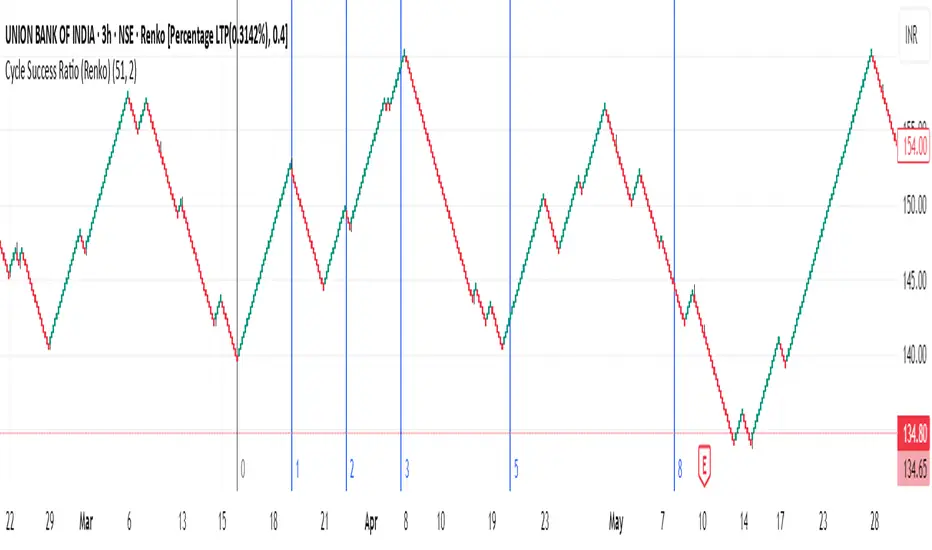
CYCLE RESEARCH PRO - FIXEDCYCLE RESEARCH PRO โ Fixed & Cleaned (2025 Edition)
The only public T+21 / T+35 / T+147 cycle tracker that actually works.
Features:
โข Exact days since the legendary GME sneeze (28 Jan 2021)
โข Highlights active T+21, T+35, and T+147 windows (ยฑ user-defined tolerance)
โข Live countdown to next cycle date for all three
โข FTD Proxy detector (extreme volume + true-range spike)
โข Clean wide dashboard โ no clutter
โข Background glows when any cycle window is active
โข Built-in alerts including the infamous โT+21 + FTDโ combo
โข 100 % non-repainting โ uses only confirmed bars
โข Zero errors, zero warnings, Pine v6 native
Made famous in the meme-stock wars.
Now cleaned, fixed, and ready for the next run.
Works on GME, AMC, BBBY, any stock or crypto.
Use it. Share it. Profit.
Not financial advice. Just math & cycles.
โ Published with love for the apes, degens, and cycle chads everywhere
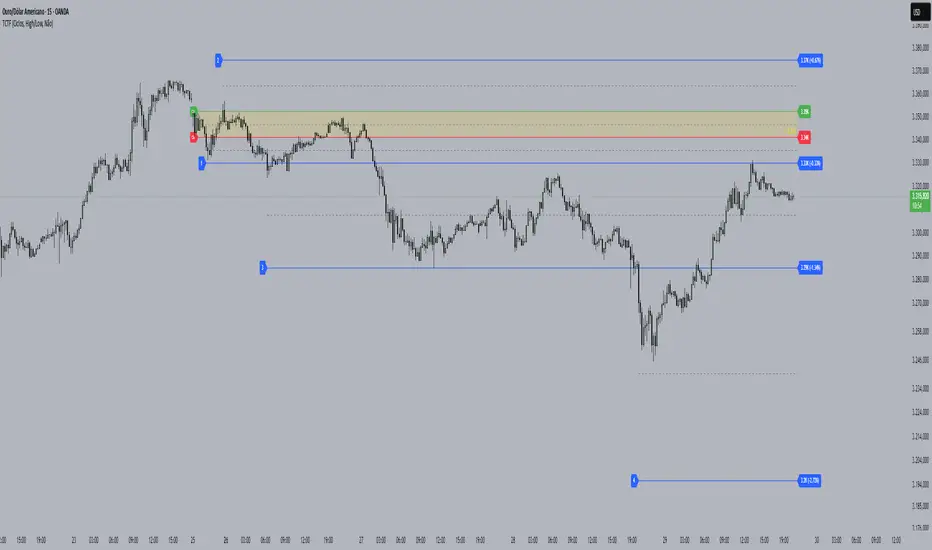
Cycle Theory + Frequency TheoryCycle Theory attempts to predict, through volatility, support/resistance points where the market may reach/reverse a trend. This theory's calculation is based on a reference candle that the user chooses, usually the first candle of the day/week's session. From this point on, if the level is broken upwards or downwards, the 1st Cycle begins with the same distance between the high/low or open/close of the reference candle. From the 2nd Cycle onwards, the size becomes the sum of all the last cycles formed, and so on.
Frequency Theory is similar, but its levels always have the same size as the high/low or open/close of the reference candle.
CyclesTime based indicator attempting to show changes in a cycle based on the different time elapsed between new highs and new lows in a given time period. Useful when combined with elliott wave price structure. A drop above/below 0 suggests a wave 4 whilst new highs/lows of the indicator suggest whether a bullish or bearish trend is in place. You can change the time cycle as you like. Any Q's please post, i'll be happy to answer them. (If I can)
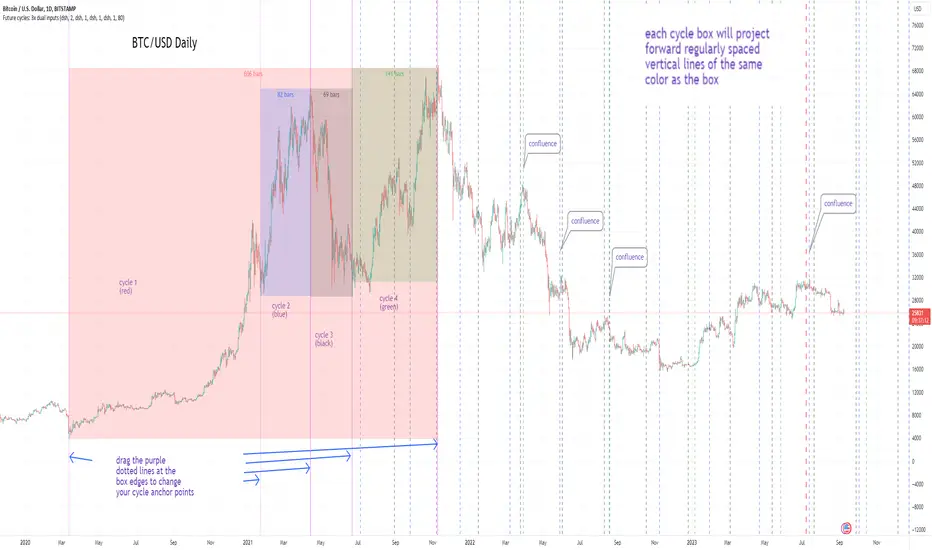
Cycles: 4x dual inputs: Swing / Time Cycles projected forward//Purpose/Premise:
To project forward vertical 'cycle' lines based on user-input anchor points, and to search for confluence.
The idea being that if several well-anchored cycles agree (i.e. we see multiple bunched vertical line confluence in the future), then this may add support to an already existing trade idea, or may indicate an increased likelihood of a shift in direction.
//Usage & notes:
~In the above chart I've anchored to obvious swing lows and swing highs in Btc/Usd from 2020-2022. You could also use fixed time-based cycles from a favored start anchor point. Bars per cycle are printed at the top of each cycle box if your're interested in time cycles. I.e. for 1, 2, 3 month cycles: for BTC you could use 30, 60, 90 bars on daily; for S&P you could use 20, 40, 60 bars on daily.
~On first loading the indicator you will be asked select 'start date', and 'end date' for each of 4 sessions (8x clicks on chart). After this you can easily reset points by clicking the indicator display line three dots>> reset points. Or you can simply drag the vertical box edges (purple lines) to change your cycle anchor points.
~Be sure the start anchor point is before the end anchor point or box/lines won't appear.
~When you drop down to low timeframes you might get bar_index error due to history available: you need then to click the three dots on indicator display line >> reset points >> 8x clicks on the chart.
~Vertical projected lines will match the color of the cycle box they origninate from.
~Lines will project into the future as far as is allowed by tradingview (500 bars max)
//Inputs:
~Time start and end dates for each cycle (change these as described above, or input manually)
~Show/hide each cycle (default is show all 4)
~Formatting options: color of forward projected lines, line width, line style, line / box / text color.
~Box transparancy: Set to 100 to make boxes invisible & declutter the chart. Set to 0 for maximum opacity. Default is 80.
thanks to @Sathyamurthie for his ideas on cycle confluence which caused me to write this.
CycleSync | QuantEdgeBIntroducing CycleSync by QuantEdgeB
Overview
CycleSync is a powerful valuation and cycle-tracking system designed to provide insights into asset price behavior across different phases of market cycles. It integrates on-chain data, price-based indicators, and risk-adjusted metrics to offer a comprehensive valuation model that helps traders and investors identify accumulation, distribution, and momentum shifts.
This system is ideal for those who want data-driven confirmation of market tops and bottoms, leveraging a blend of statistical measures, trend-following techniques, and historical on-chain valuations.
_____
Key Features
1. Multi-Factor Valuation Framework
Incorporates a blend of on-chain, momentum, and price-based indicators to assess market cycles in real-time. Helps determine if an asset is overvalued, fairly valued, or undervalued over long term horizon.
2.Market Cycle Recognition
Tracks key macro and micro cycle shifts, identifying trends such as accumulation, expansion, distribution, and contraction phases.
3.Dynamic Valuation
CycleSync employs Z-score standardization and adaptive rescaling to continuously refine overbought and oversold thresholds based on evolving market conditions. Unlike static valuation models, which rely on fixed levels, CycleSync dynamically recalibrates these boundaries by analyzing historical price distributions and deviations from the mean.
4.Comprehensive Dashboard
Presents cycle indicators and valuation scores in a structured table format.
Displays color-coded overbought and oversold signals for quick interpretation.
_____
How It Works
1.On-Chain & Price-Based Data Collection
Gathers key market cycle indicators like MVRV, NUPL, SOPR, CVDD, VWAP, Pi-Cycle, RSI, and Risk Ratios to assess historical valuation.
2.Standardization & Rescaling
Each metric is normalized using either Z-score calculations or high-low rescaling, ensuring fair contribution across different data sources. By applying statistical normalization techniques, the system ensures that extreme valuations are detected relative to the asset's own historical behavior rather than arbitrary thresholds.
3.Valuation Score & Interpretation
๐น CycleSync Score Ranges
- ๐ Strongly Oversold (-2 and below) โ Market is extremely undervalued; potential reversal.
- ๐ Moderately Oversold (-1.5 to -2) โ Discounted market conditions, buying interest may emerge.
- ๐ Slightly Oversold (-0.5 to -1.5) โ Possible accumulation phase.
- โ Fair Value (-0.5 to +0.5) โ Market trading at equilibrium.
- ๐ Slightly Overbought (+0.5 to +1.5) โ Initial signs of market strength.
- ๐ Moderately Overbought (+1.5 to +2) โ Market heating up, caution warranted, selling interest may emerge.
- ๐ Strongly Overbought (+2 and above) โ Extreme valuation, increased risk of correction.
This classification helps traders gauge overall market sentiment and make better allocation decisions.
Note : Past valuations and buy/sell signals generated by CycleSync do not guarantee future performance. Market conditions can change, and proper risk management should always be applied.
____
Use Cases
โ
Crypto Traders & Long-Term Investors
Identify potential major market tops and bottoms using on-chain and price-based cycle indicators.Confirm long-term accumulation or distribution phases with CycleSyncโs multi-cycle tracking.
โ
Macro Trend Followers
Detect macro bull and bear cycle shifts by integrating valuation metrics with trend-following strategies.
โ
Mean Reversion & Rotational Traders
Exploit valuation mean reversion strategies when assets enter extreme overvaluation or undervaluation zones. Rotate capital efficiently between risk-on and risk-off assets based on CycleSyncโs valuation models.
โ
Risk Management & Portfolio Allocation
Adjust portfolio exposure by scaling in/out of positions based on historical valuation insights.
Use CycleSyncโs Risk Ratios & CVDD metrics to refine entry and exit strategies.
_____
๐ Optimized for Bitcoin , Yet "Universally" Adaptable ๐
CycleSync is primarily optimized for Bitcoin , leveraging their extensive on-chain and market data to provide robust long-term valuation insights. However, the system remains flexible and can be applied to other assets ๐๐โprovided they have sufficient historical price data to support reliable statistical calculations.
Since CycleSync incorporates volume-based metrics, it is essential that the selected chart's ticker provides accurate volume data to function properly. For assets with limited history, results may be less reliable, as long-term valuation models depend on deep market data for precision.
_____
Conclusion
CycleSync is a powerful full-cycle valuation system designed to provide deep market insights ๐ by blending on-chain metrics, statistical rescaling, and technical analysis. Whether you're tracking Bitcoin or other assets with sufficient historical data, this tool offers a structured framework for identifying overbought/oversold conditions, potential cycle tops/bottoms, and long-term market positioning.
With its dynamic adaptability, intuitive scaling mechanisms, and multi-metric integration โก, CycleSync empowers traders and investors to make more informed, data-driven decisions ๐. While no valuation model is infallible, combining CycleSync with broader market context and risk management strategies enhances its effectiveness.
๐น Who Should Use Sentival?
โ
Swing Traders & Long-Term Investors looking for structured valuation metrics.
โ
Quantitative & Systematic Traders incorporating multi-factor models.
โ
Portfolio Managers optimizing exposure to different market regimes.
โ
Use CycleSync as a guiding frameworkโnot a standalone signalโ and gain a clearer perspective on the ever-evolving market cycles!
๐น Disclaimer: Past performance is not indicative of future results. No trading strategy can guarantee success in financial markets.
๐น Strategic Advice: Always backtest, optimize, and align parameters with your trading objectives and risk tolerance before live trading.
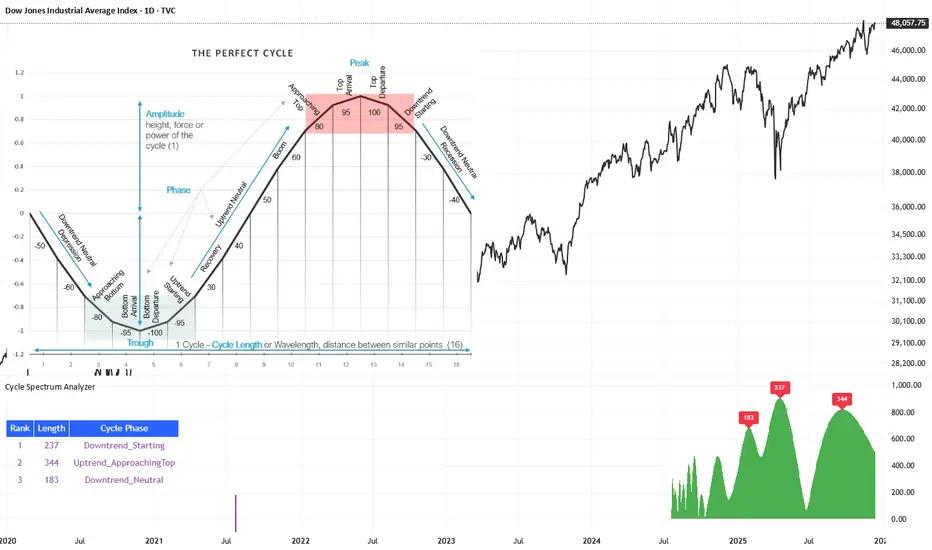
Cycle Spectrum AnalyzerCycle Spectrum Indicator โ Short Description
This indicator computes a visual Fourier cycle spectrum from the input price data to reveal the marketโs dominant cyclical behaviour. The price series is first detrended using a HodrickโPrescott filter, after which a specialized Fourier analysis variant extracts the cycle components.
The resulting spectrum displays peaks that represent the dominant cycles present in the data, where each peakโs cycle length and amplitude indicate the strength and duration of the underlying rhythm. The most significant peaks are ranked, highlighting the top cycles currently driving market movement. Each detected cycle also includes a phase value, describing the cycleโs position at the most recent bar (e.g., topping, bottoming, rising, falling).
The indicator can be used to:
Identify the top 3 dominant cycles with their length and phase.
Analyze the current market state by interpreting these phases.
Feed the dominant cycle lengthsโoften half the primary cycleโinto other technical indicators for improved parameter tuning.
Project cycles forward to estimate upcoming turning points and anticipate potential trend shifts.
Additional Explanation of the included visual example image
Left Area โ The Theoretical โPerfect Cycleโ
The left part of the illustration presents a theoretical, perfectly smooth sine-wave cycle. This serves as a reference model to explain the core cycle parameters:
Cycle Length โ The full wavelength of one complete oscillation (from trough to trough or peak to peak).
Phase โ The current position within that cycle, expressed both numerically and as an easy-to-read text label such as Bottom_Departure, Uptrend_Neutral, Approaching Top, or Top_Departure.
The diagram highlights visually how a cycle progresses through bottoming, rising, peaking, and declining phases, matching the phase descriptions used in the indicatorโs output. This helps translate raw phase angles into intuitive market-state labels (e.g., recovery, boom, topping, recession).
Right Area โ The Price Series Used for Analysis
On the right, the actual price chart (e.g., Dow Jones Industrial Average) is displayed. This is the dataset from which the Fourier cycle spectrum is computed.
At the bottom of this chart section, a purple bar indicates the amount of historical data included in the cycle analysis. Because Fourier-based methods depend strongly on sample size, this visual cue shows how far back the indicator collected and processed data before generating the spectrum.
Bottom Area โ The Cycle Spectrum Output Pane
The lower pane contains the Cycle Spectrum Analyzer output:
It displays the cycle spectrum at the most recent bar, where each green peak corresponds to a detected cycle.
Peak height = amplitude (strength) of the cycle
Peak position (horizontal) = dominant cycle length
The largest peaks represent the strongest cycles currently present in the detrended price series.
Next to the spectrum, a ranked table lists the Top 3 dominant cycles, showing:
Rank (1 = strongest)
Cycle Length (in bars)
Phase Description (interpreting where that cycle is right now)
This concise summary allows users to quickly understand:
Which cycles are strongest,
How long they are,
And whether they are currently bottoming, topping, rising, or falling.
How the Indicator Works & How It Can Be Adjusted
Calculation Only at the Last Bar
The indicator performs its full Fourier-based cycle decomposition exclusively on the most recent bar. This ensures that the spectrum always reflects the current market state without repeatedly recalculating historical spectra. The result is an efficient, real-time snapshot of the dominant cycles influencing the price at the latest point in time.
Works on Any Symbol and Any Timeframe
Because the analysis operates directly on the provided price series, the indicator is compatible with all markets and all timeframesโstocks, indices, forex, crypto, futures, and intraday charts alike.
The detected cycle lengths always refer to the selected chartโs bar interval (e.g., 240-bar cycle on a 1h chart โ 240 hours; same cycle on a daily chart โ 240 days).
Adjustable Historical Lookback (Default: 1100 Bars)
The accuracy of cycle detection depends on the amount of historical data used. The indicator provides a parameter allowing you to specify how many past bars should be included in the Fourier calculation.
Standard value: 1100 bars
Increasing the lookback allows detection of longer cycles, but may dilute short-term characteristics.
Decreasing it focuses on shorter and medium-term cycles, increasing responsiveness but reducing visibility of long-duration rhythms.
By tuning this lookback parameter and choosing an appropriate timeframe, traders can adapt the cycle spectrum to match their analytical styleโshort-term, medium-term, or long-term cycle interpretation.
Skrip berbayar
Cycle Indicator CS7This indicator visualizes cyclical structures (including inverse cycles) for financial instruments.
It is highly customizable and comes with a default configuration optimized for cryptocurrencies on a 45-minute timeframe, highlighting the following cycles:
โข T-3: Daily cycles
โข T-2: Approximately 2-day cycles
โข T+1: Bi-weekly cycles
โข T-1: Approximately 4-day cycles
โข T: Weekly cycles
The same setup can also be applied effectively on a 24-hour timeframe, highlighting the following longer-term cycles:
โข T+2: Monthly cycles
โข T+3: Quarterly cycles
โข T+4: Semi-annual cycles
โข T+5: Annual cycles
โข T+6: Bi-annual cycles
Users can customize the configurations to suit the specific characteristics of any financial instrument.
Additionally, the indicator includes a prediction system that approximates future cycles, marking them with a โ?โ.
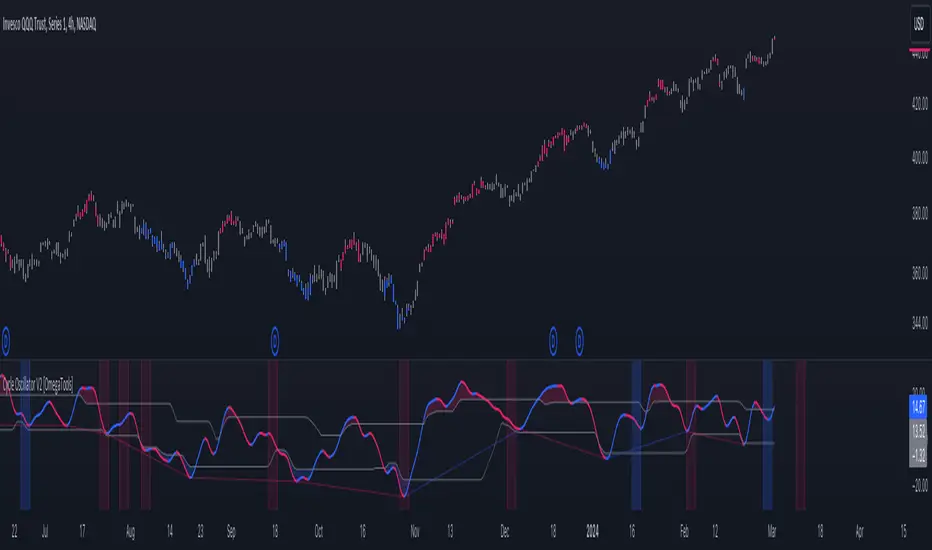
Cycle Oscillator V2 [OmegaTools]Introducing the "Cycle Oscillator" by OmegaTools, an innovative addition to your TradingView analysis toolkit. This script is designed to offer a unique approach to understanding market cycles without the need for volume data, making it versatile across various market conditions and asset classes.
Key Features:
- Cycle Length Customization: Tailor the cycle length from 10 to 200 bars to fit the specific rhythm of the market you're analyzing, ensuring relevance and precision.
- Smoothness Adjustment: Fine-tune the oscillator's smoothness to capture the essence of market movements with options ranging from 1 to 20.
- Aesthetic Flexibility: Choose your preferred colors for the oscillator's upward and downward movements, personalizing your chart to your liking.
- Historical Mode: Toggle the historical mode to either focus on real-time analysis or review past cycle data for backtesting and study.
- Candle Color Modes: Enhance your visual analysis with optional candle coloring based on trend, signals, or extensions, providing immediate insight into market conditions.
Usage Guide:
1. Setting Up: Easily adjust the cycle length and smoothness to match the market's current volatility and your trading style.
2. Understanding Market Cycles: The oscillator plots the average deviation from three distinct moving averages, offering a clear view of potential market turns or continuations.
3. Identifying Overbought/Oversold Conditions: Utilize the upper and lower bounds to recognize extreme market conditions, guiding your entry and exit decisions.
4. Visual Enhancements: Customize the visual aspects, including colors and candle coloring, to make your analysis both effective and aesthetically pleasing.
5. Anticipating Market Movements: The script provides forward-looking lines to suggest potential future highs or lows, aiding in predictive analysis.
Designed with both novice and experienced traders in mind, the "Cycle Oscillator" is a testament to OmegaTools' commitment to providing high-quality, innovative trading tools. Whether you're looking to refine your trading strategy or seeking new analytical perspectives, this script offers a comprehensive solution to navigating the ebbs and flows of the financial markets.
Join the community of traders enhancing their TradingView experience with the "Cycle Oscillator" by OmegaTools. Start exploring deeper market insights and unlock new trading opportunities today.
Cycles MasterCycles Master Indicator
The "Cycles Master" indicator is a powerful tool designed to reveal cyclical patterns within market trends. It operates with precision, allowing users to adjust cycle lines to the top of prices using the "Multiplication" parameter.
Multiplication: Aligning Cycle Lines
The "Multiplication" parameter serves a crucial role in aligning cycle lines with the upper extremes of price action. Increasing this value adjusts the cycles upward, offering a clearer view of cyclical patterns in relation to price peaks.
MA Length: Cycle Frequency
Meanwhile, the "MA Length" parameter determines the frequency of cycles displayed on the chart. A shorter length leads to more frequent cycles, capturing shorter-term market fluctuations. In contrast, a longer length smooths out cycles, revealing longer-term trends.
Interpreting the Indicator:
Each line represents a unique cyclical variation derived from the chosen moving average type and its parameters.
The alignment of these cycles with price peaks assists in spotting potential trend reversals or shifts in market momentum.
Usage Recommendations:
Adjust the "Multiplication" value to precisely align cycle lines with price peaks, aiding in accurate identification of cyclic patterns in relation to market highs.
Tailor the "MA Length" parameter to capture cycles of varying frequencies, catering to short-term fluctuations or longer-term trends.
Complement this indicator with additional analysis tools for a comprehensive market assessment.
Gradient Vertical Box: Cycle Line Colors
Located at the middle right of the chart, the gradient vertical box showcases varying colors that correspond to the cycle lines displayed. The colors portray the intensity and diversity of the cycles observed within the market.
Within this gradient vertical box, the top of the gradient is marked with an "H," symbolizing the Highs of cycles, while the bottom displays an "L," signifying the Lows of cycles. This arrangement provides a clear visual reference for interpreting the cycle lines.
Risk Advisory:
While the indicator assists in market analysis, it should be used alongside other indicators or analysis methods.
It does not guarantee specific market outcomes; hence, traders should practice caution and employ proper risk management strategies.
Cycle Swing MomentumAdaptive Ultra-Smooth Momentum indicator
The Cycle-Swing-Indicator "CSI" provides an optimized "momentum" oscillator based on the current dominant cycle by looking at the swing of the dominant cycle instead of the raw source momentum. Offering the following improvements:
Smoothness
Zero delay
Sharpness at turning points
Robust and adaptable to market conditions
Accurate deviation detection
The following common problems with standard indicators are solved by this indicator:
First, normal indicators introduce a lot of false signals due to their noisy signal line. Second, to compensate for the noise, one would normally try to add some smoothing. But this only results in adding more delay to the indicator, which makes it almost useless. Third, standard indicators require a length adjustment to derive reliable signals. However, you never know how to set the right length.
All three problems described above are solved by the developed adaptive cyclic algorithm.
The above chart shows current Bitcoin 4h data from the last days as of writing with the proposed signal reading for this indicator. The standard momentum indicator is included for comparison.
HOW TO USE
The indicator works without any parameter and can be applied to any chart and any time-frame. It will adapt automatically to the Dominant Cycle and use the dominant cycle of the source data to derive the ultra smooth momentum curve. Adaptive upper/lower bands are included and highlight areas with extreme readings. Automatic divergence detection can be turned off/on.
HOW TO READ
The indicator can be used like any oscillator. In addition, it provides adaptive high and low bands.
* Look for turns above the upper/lower bands
* Look for divergences between source and signals line
Further reading/Original source:
The indicator uses the dominant cycle to optimize signal, smoothing and cyclic memory. To get more in-depth information on the Cycle Swing Indicator, please read Chapter 10 "Cycle Swing Indicator: Trading the swing of the dominant cycle" of the book "Decoding the Hidden Market Rhythm, Part 1" available at your favorite book store.
Related ideas:
Please also check the cyclic RSI indicator which also uses cyclic information to improve the signal.
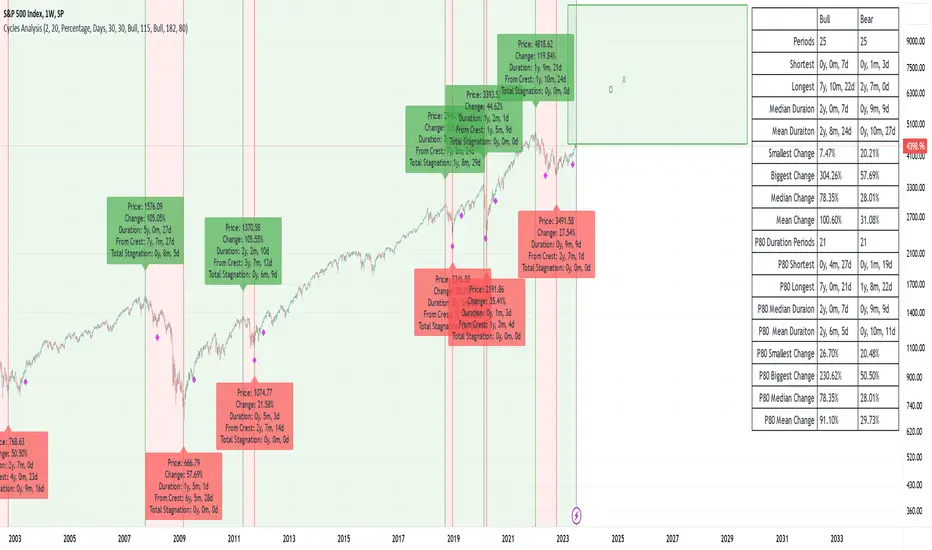
Cycles AnalysisI strongly believe in cycles, so I wanted to create something that would give a visual representation of bull/bear markets and give a prediction based on the previous data. It's up to you how to decide what is a bull/bear cycle. There is no single rule for all assets because 20% drop in SP500 starts a bear market in traditional markets, while 35% drop for Bitcoin is a Tuesday. You have two options on how to decide when markets turn: either by a % change (traditional definition) or if there is no new high/low after X days. A softer version to show periods of no new highs/lows is to use the Stagnation option. Stagnation periods hava the same logic as the cycle change by X days: if there is no new high/low then we treat this period as a stagnation. The difference is that stagnation periods do not change cycle directions and do not participate in calculations.
The script also draws a possible "predictions" zone where the current cycle might end up. There is no magic here, it just takes previous cycles' size to draw the possible boundaries. If you decide to use percentiles then the box area will be taken from the percentiles calculations, otherwise it will come from the full data. "x" in the predictions zone represents a target mean (average) value, "o" represents a target median value.
A few things to keep in mind:
- this script is not supposed to be used in trading. It was created for analysis. It repaints. And when I say "it repaints" - it might like repaint the last 6 months of data if a new low comes and we are in a stagnation period (aka not a financial advice).
- it doesn't work with replays as it does calculations only once on the last candle.
- you need at least 3 periods to be able to calculate percentiles. And after this it will remove at least 1 period on each side. Which means that 90 percentile will not be a real 90 percentile until you have enough periods for it to be (20 in this specific case).
- it assumes that a year = 360 days, and a month = 30 days. So the duration presentation might not be exact, until you move to the day level.
- I had macro analysis in mind when I created the script, but nothing stops you from using it in a 1m time frame for BTC. Just change the time duration presentation.
- the last period is not finished, so it doesn't participate in calculations.
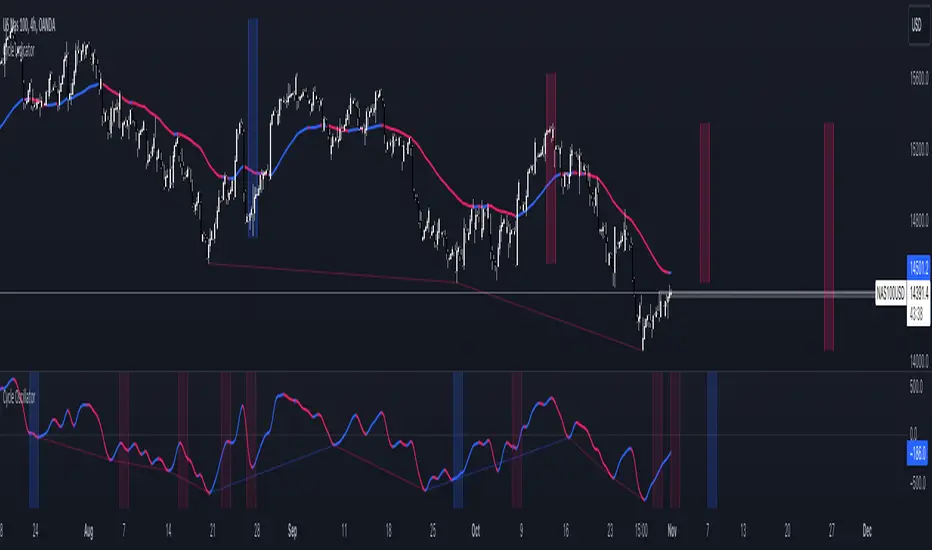
Cycle OscillatorThe Cycle Oscillator is a tool developed to help traders analyze market cycles thanks to a simplified version of the Hurst theory and the easy visualization provided by the detrended cycle.
This indicator has two functions:
- The first one is the plotting of a line that oscillates above and below the zero line, which can be used to find the cycle direction and momentum
- The second feature is the next-cycle bottom forecaster, useful for estimating the timing of the future pivot low based on the pivot low of the oscillator.
This last feature shows graphically the period in which the next low will probably happen, using as a calculation method the timing of the previous indicator's lows.
Additionally, the user can choose to modify the cycle length to analyze bigger or smaller price movements.
This indicator can be greatly used in combination with other Cycle Indicators to gain more confluence in the plotted time areas.
Cycle Forecast + MACD Divergence (Kombi v6 FULL)This indicator merges two powerful analytical models:
๐ฎ 1. Dominant Cycle Forecasting
The script automatically identifies major structural market cycles by detecting significant swing highs and lows.
It then fits a sinusoidal wave (amplitude, phase, and period) to the dominant cycle and projects it into the future.
Features:
Automatically extracts large, dominant cycles (no noise, no small swings)
Smooth sinusoidal historical cycle visualization
Future cycle projection for 1โ2 upcoming cycle periods
Dynamic amplitude and phase alignment based on market structure
Helps anticipate cycle tops and bottoms for long-term timing
๐ 2. MACD Divergence Detection
Full divergence detection engine using MACD or MACD Histogram.
Detects:
Bullish Divergence
Price โ while MACD (or Histogram) โ
โ Possible trend reversal upward
Bearish Divergence
Price โ while MACD (or Histogram) โ
โ Possible trend reversal downward
Features:
Pivot-based divergence confirmation (no repaint)
Choice of MACD Line or Histogram as divergence source
Labels + connecting divergence lines
Works across all markets and timeframes
โ๏ธ Smart Auto-Pivot System
The indicator optionally adjusts pivot sensitivity based on timeframe:
Weekly โ tighter pivots
Daily โ medium pivots
Intraday โ wider pivots
Ensures stable, meaningful divergence signals even on higher timeframes.
๐ฏ Use cases
Identify upcoming cycle highs/lows
Spot major trend reversals early
Improve swing entries with MACD divergences near cycle turns
Combine forecasting with momentum exhaustion
Suitable for crypto, stocks, indices, forex & commodities
๐ง Why this indicator is powerful
This tool blends time-based cycle forecasting with momentum-based divergence signals, giving you a unique perspective of where the market is likely to turn.
Cycles reveal when a move may occur.
Divergences reveal why a move may occur.
Combined, they offer highly effective market timing.
Cycle IndicatorThe Cycle Indicator is a tool developed to help traders analyze market cycles thanks to a simplified version of the Hurst theory.
This indicator has two functions:
- The first one is the plotting of a line that can be used to find the cycle direction and momentum
- The second feature is the next-cycle bottom forecaster, useful for estimating the timing of the future pivot low.
This last feature shows graphically the period in which the next low will probably happen, using as a calculation method the timing of the previous lows.
Additionally, the user can choose to extend this time zone or to limit them to the range between the last pivot high and low.
CYCLE BY RiotWolftradingDescription of the "CYCLE" Indicator
The "CYCLE" indicator is a custom Pine Script v5 script for TradingView that visualizes cyclic patterns in price action, dividing the trading day into specific sessions and 90-minute quarters (Q1-Q4). It is designed to identify and display market phases (Accumulation, Manipulation, Distribution, and Continuation/Reversal) along with key support and resistance levels within those sessions. Additionally, it allows customization of boxes, lines, labels, and colors to suit user preferences.
Main Features
Cycle Phases:
Accumulation (1900-0100): Represents the phase where large operators accumulate positions.
Manipulation (0100-0700): Identifies potential manipulative moves to mislead retail traders.
Distribution (0700-1300): The phase where large operators distribute their positions.
Continuation/Reversal (1300-1900): Indicates whether the price continues the trend or reverses.
90-Minute Quarters (Q1-Q4):
Divides each 6-hour cycle (360 minutes) into four 90-minute quarters (Q1: 00:00-01:30, Q2: 01:30-03:00, Q3: 03:00-04:30, Q4: 04:30-06:00 UTC).
Each quarter is displayed with a colored box (Q1: light purple, Q2: light blue, Q3: light gray, Q4: light pink) and labels (defaulted to black).
Support and Resistance Visualization:
Draws boxes or lines (based on settings) showing the high and low levels of each session.
Optionally displays accumulated volume at the highs and lows within the boxes.
Daily Lines and Last 3 Boxes:
How to Use the Indicator
Step 1: Add the Indicator to TradingView
Open TradingView and select the chart where you want to apply the indicator (e.g., UMG9OOR on a 5-minute timeframe, as shown in the screenshot).
Go to the Pine Editor (at the bottom of the TradingView interface).
Copy and paste the provided code.
Click Compile and then Add to Chart.
Step 2: Configure the Indicator
Click on the indicator name on the chart ("CYCLE") and select Settings (or double-click the name).
Adjust the options based on your needs:
Cycle Phases: Enable/disable phases (Accumulation, Manipulation, Distribution, Continuation/Reversal) and adjust their time slots if needed.
90-Minute Quarters: Enable/disable quarters (Q1-Q4).
Step 3: Interpret the Indicator
Identify Cycle Phases:
Observe the red boxes indicating the phases (Accumulation, Manipulation, etc.).
The high and low levels within each phase are potential support/resistance zones.
If volume is enabled, pay attention to the accumulated volume at highs and lows, as it may indicate the strength of those levels.
Use the 90-Minute Quarters (Q1-Q4):
The colored boxes (Q1-Q4) divide the day into 90-minute segments.
Each quarter shows the price range (high and low) during that period.
Use these boxes to identify price patterns within each quarter, such as breakouts or consolidations.
The labels (Q1, Q2, etc.) help you track time and anticipate potential moves in the next quarter.
Analyze Support and Resistance:
The high and low levels of each phase/quarter act as support and resistance.
Daily lines (if enabled) show key levels from the previous day, useful for planning entries/exits.
The "last 3 boxes below price" (if enabled) highlight potential support levels the price might target.
Avoid Manipulation:
During the Manipulation phase (0100-0700), be cautious of sharp moves or false breakouts.
Use the high/low levels of this phase to identify potential traps (as explained in your first question about manipulation candles).
Step 4: Trading Strategy
Entries and Exits:
Support/Resistance: Use the high/low levels of phases and quarters to set entry or exit points.
For example, if the price bounces off a Q1 support level, consider a buy.
Breakouts: If the price breaks a high/low of a quarter (e.g., Q2), wait for confirmation to enter in the direction of the breakout.
Volume: If accumulated volume is high near a key level, that level may be more significant.
Risk Management:
Place stop-loss orders below lows (for buys) or above highs (for sells) identified by the indicator.
Avoid trading during the Manipulation phase unless you have a specific strategy to handle false breakouts.
Time Context:
Use the quarters (Q1-Q4) to plan your trades based on time. For example, if Q3 is typically volatile in your market, prepare for larger moves between 03:00-04:30 UTC.
Step 5: Adjustments and Testing
Test on Different Timeframes: The indicator is set for a 5-minute timeframe (as in the screenshot), but you can test it on other timeframes (e.g., 1-minute, 15-minute) by adjusting the time slots if needed.
Adjust Colors and Styles: If the default colors are not visible on your chart, change them for better clarity.
---
๐ 1. **Accumulation: Strong Institutional Activity**
- During the **accumulation phase, we see **high volume: 82.773K, which suggests strong buying interest**, likely from institutional players.
- This sets the base for the following upward move in price.
---
๐ 2. **Manipulation: False Breakout with Lower Volume**
- Later, there's a manipulation phase where price breaks above previous highs, but the volume (71.814K) is **lower than during accumulation**.
- This implies that buyers are not as aggressive as beforeโno real demandbehind the breakout.
- Itโs likely a bull trap, where smart money is selling into the breakout to exit their positions.
---
### ๐ 3. Distribution: Weakness and Lack of Demand
- The market enters a distribution phase, and volume drops even further (only 7.914K).
- Price struggles to go higher, and you start seeing rejections at the top.
- This shows that demand is drying up, and smart money is offloading positions**โnot accumulating anymore.
---
### ๐ก Why Take the Short Here?
- Volume is not increasing with new highsโshowing weak demand**.
- The manipulation volume is weaker than the accumulation volume, confirming the breakout was likely false.
- Structure starts to break down (Q levels falling), which confirms weakness.
- This creates a high-probability short setup:
- **Entry:** after confirmation of distribution and structural breakdown.
- **Stop loss:** above the manipulation high.
- **Target:** down toward previous lows or value zones.
---
### โ
Conclusion
Since the manipulation volume failed to exceed the accumulation volume, the breakout lacked real strength. Combined with decreasing volume in the distribution phase, this indicates fading demand and supply taking controlโwhich justifies entering a short position.
Optimized Future Time Cycles V2Time Cycle-Based Indicator Overview
This script utilizes Time Cycles to visually display the periodic fluctuations of the past and future, helping to predict key market turning points and trend shifts.
The indicator is fully customizable and marks periodic vertical lines and labels on the chart based on a specified reference date.
1. Key Features
Time Cycle Settings
Displays various user-defined time cycles (e.g., 9 days, 17 days, 26 days) visually on the chart.
Each cycle is distinguished by unique colors and labels for clear identification.
Allows users to set a reference date, from which past and future cycles are calculated.
Past and Future Cycle Visualization
Future Cycles:
Predicts potential points of market fluctuations or trend changes in the future.
Vertical lines represent future turning points based on the defined time cycles.
Past Cycles:
Displays how cyclical patterns manifested in historical market data.
Helps identify recurring patterns and similar historical market conditions.
Customizable Visuals
Adjust line styles (solid, dashed, etc.) and label spacing for a cleaner chart, even with multiple cycles displayed.
Separately toggle the visibility of past and future cycles for a more tailored analysis experience.
2. How to Use and Interpret the Indicator
Setting the Reference Date
The reference date is crucial for this indicator and works best when set to significant market events or turning points.
Both past and future cycles are calculated based on the reference date, and overlapping cycles may indicate periods of high volatility or strong trend shifts.
Cycle Analysis
Interpretation by Cycle Duration:
Short-term Cycles (9, 17 days): Useful for predicting quick market fluctuations.
Mid- to Long-term Cycles (26, 52, 200 days): Ideal for identifying major trend changes.
Overlapping Cycles:
When multiple cycles converge, significant turning points or strong market movements are likely.
Importance of Past Cycles
Past cycles are invaluable for identifying repetitive patterns in the market.
For example, analyzing strong turning points from past cycles can help anticipate similar scenarios in the future.
3. Tips for Using the Indicator
Optimize Line Styles:
When displaying both past and future cycles, charts may become cluttered. Adjusting line styles or colors can help maintain visual clarity.
Short-term vs. Long-term Cycles:
Short-term Cycles: Best suited for strategies like scalping or day trading.
Long-term Cycles: Useful for capturing major trend shifts or identifying macroeconomic changes.
Recommended Combination with Other Indicators:
Combine the Time Cycle indicator with moving averages, wave indicators, RSI, or Bollinger Bands for better results.
The time cycle identifies the timing of turning points, while tools like moving averages or RSI provide insights into trend direction during these critical moments.
4. Conclusion
This Time Cycle indicator visualizes past and future periodic fluctuations, enabling effective predictions of market trends and turning points.
The reference date and overlapping cycles are essential for pinpointing critical turning points.
The newly added past cycle visualization feature enhances the ability to recognize recurring patterns and leverage historical data for more accurate predictions.
์๊ฐ ์ฃผ๊ธฐ(Time Cycle) ๊ธฐ๋ฐ ์งํ ์๊ฐ
์ด ์คํฌ๋ฆฝํธ๋ **์๊ฐ ์ฃผ๊ธฐ(Time Cycle)**๋ฅผ ํ์ฉํด ๊ณผ๊ฑฐ์ ๋ฏธ๋์ ์ฃผ๊ธฐ์ ๋ณ๋์ ์๊ฐ์ ์ผ๋ก ๋ณด์ฌ์ฃผ์ด, ์์ฅ์ ์ถ์ธ ๋ณํ ์์ ๊ณผ ๋ณ๊ณก์ ์ ์์ธกํ๋ ๋ฐ ๋์์ ์ค๋๋ค.
์งํ๋ ์ฌ์ฉ์ ์ ์๊ฐ ๊ฐ๋ฅํ๋ฉฐ, ์ค์ ๋ ๊ธฐ์ค ๋ ์ง๋ฅผ ๊ธฐ๋ฐ์ผ๋ก ์ฃผ๊ธฐ์ ์ธ ์์ง์ ๊ณผ ๋ ์ด๋ธ์ ์ฐจํธ์ ํ์ํฉ๋๋ค.
1. ์ฃผ์ ๊ธฐ๋ฅ
์๊ฐ ์ฃผ๊ธฐ ์ค์
์ฌ์ฉ์๊ฐ ์ค์ ํ ๋ค์ํ ์๊ฐ ์ฃผ๊ธฐ(์: 9์ผ, 17์ผ, 26์ผ ๋ฑ)๋ฅผ ์๊ฐ์ ์ผ๋ก ํ์.
๊ฐ ์ฃผ๊ธฐ๋ ๊ณ ์ ํ ์์๊ณผ ๋ ์ด๋ธ๋ก ๊ตฌ๋ถ๋์ด ๋ช
ํํ๊ฒ ์ฐจํธ์ ๋ํ๋ฉ๋๋ค.
**๊ธฐ์ค ๋ ์ง(reference date)**๋ฅผ ์ค์ ํ์ฌ, ํด๋น ๋ ์ง๋ฅผ ๊ธฐ์ค์ผ๋ก ๊ณผ๊ฑฐ์ ๋ฏธ๋์ ์ฃผ๊ธฐ๋ฅผ ๊ณ์ฐํฉ๋๋ค.
๋ฏธ๋์ ๊ณผ๊ฑฐ ์ฃผ๊ธฐ ํ์
๋ฏธ๋ ์ฃผ๊ธฐ:
๋ฏธ๋์ ์์ฅ ๋ณ๋ ์์ ์ด๋ ์ถ์ธ ๋ณํ ๊ฐ๋ฅ์ฑ์ด ๋์ ์ง์ ์ ์์ธกํ ์ ์์ต๋๋ค.
์ค์ ๋ ์๊ฐ ์ฃผ๊ธฐ์ ๋ฐ๋ผ ๋ฏธ๋ ๋ณ๊ณก์ ์ ์ฐจํธ์ ์์ง์ ์ผ๋ก ๋ํ๋
๋๋ค.
๊ณผ๊ฑฐ ์ฃผ๊ธฐ:
๊ณผ๊ฑฐ ์์ฅ์์ ์ฃผ๊ธฐ์ ๋ณ๋์ด ์ด๋ป๊ฒ ๋ํ๋ฌ๋์ง ํ์ธ ๊ฐ๋ฅํฉ๋๋ค.
์ด๋ฅผ ํตํด ๋ฐ๋ณต๋๋ ํจํด์ด๋ ๊ณผ๊ฑฐ์ ์ ์ฌํ ์์ฅ ์ํฉ์ ํ์
ํ ์ ์์ต๋๋ค.
์๊ฐ์ ์ฌ์ฉ์ ์ค์
์์ง์ ์คํ์ผ(์ค์ , ์ ์ ๋ฑ)๊ณผ ๋ ์ด๋ธ ๊ฐ๊ฒฉ์ ์กฐ์ ํ์ฌ, ๋ณต์กํ ์ฐจํธ์์๋ ๊น๋ํ๊ฒ ์ ๋ณด๋ฅผ ํ์ธํ ์ ์์ต๋๋ค.
๊ณผ๊ฑฐ์ ๋ฏธ๋์ ์ฃผ๊ธฐ ํ์๋ฅผ ๊ฐ๋ณ์ ์ผ๋ก ์กฐ์ ๊ฐ๋ฅํ์ฌ ์ฌ์ฉ์ ๋ง์ถคํ ๋ถ์์ด ๊ฐ๋ฅํฉ๋๋ค.
2. ์งํ ์ฌ์ฉ ๋ฐ ํด์ ๋ฐฉ๋ฒ
๊ธฐ์ค ๋ ์ง ์ค์
**๊ธฐ์ค ๋ ์ง(reference date)**๋ ์์ฅ์์ ์ค์ํ ๋ณ๋์ด ์์๋ ๋ ์ ๊ธฐ์ค์ผ๋ก ์ค์ ํ๋ ๊ฒ์ด ๊ฐ์ฅ ํจ๊ณผ์ ์
๋๋ค.
๊ธฐ์ค ๋ ์ง๋ฅผ ๊ธฐ๋ฐ์ผ๋ก ๊ณผ๊ฑฐ์ ๋ฏธ๋ ์ฃผ๊ธฐ๊ฐ ๊ณ์ฐ๋๋ฉฐ, ์ฃผ๊ธฐ๊ฐ ๊ฒน์น๋ ์์ ์์ ๊ฐํ ๋ณ๋์ฑ์ด ๋ํ๋ ๊ฐ๋ฅ์ฑ์ด ๋์ต๋๋ค.
์ฃผ๊ธฐ ๋ถ์
์ฃผ๊ธฐ๋ณ ํด์:
๋จ๊ธฐ ์ฃผ๊ธฐ (9์ผ, 17์ผ): ๋น ๋ฅธ ๋ณ๋์ฑ์ ์์ธก.
์คยท์ฅ๊ธฐ ์ฃผ๊ธฐ (26์ผ, 52์ผ, 200์ผ): ํฐ ์ถ์ธ ๋ณํ๋ฅผ ์์ธก.
์ฃผ๊ธฐ๊ฐ ๊ฒน์น๋ ์์ ์ ์ค์ํ ๋ณ๊ณก์ ์ด ๋ ๊ฐ๋ฅ์ฑ์ด ํฌ๋ฉฐ, ์ถ์ธ ์ ํ์ ์ ํธ๋ก ๋ณผ ์ ์์ต๋๋ค.
๊ณผ๊ฑฐ ์ฃผ๊ธฐ์ ์ค์์ฑ
๊ณผ๊ฑฐ ์ฃผ๊ธฐ๋ ์์ฅ์ ๋ฐ๋ณต ํจํด์ ์ฐพ๋ ๋ฐ ์ ์ฉํฉ๋๋ค.
์๋ฅผ ๋ค์ด, ๊ณผ๊ฑฐ ์ฃผ๊ธฐ์์ ๊ฐํ ๋ณ๊ณก์ ์ด ๋ํ๋ฌ๋ ์์ ์ ๋ถ์ํ๋ฉด, ๋ฏธ๋์๋ ์ ์ฌํ ์ํฉ์ด ๋ฐ์ํ ๊ฐ๋ฅ์ฑ์ ์์ธกํ ์ ์์ต๋๋ค.
3. ์งํ ํ์ฉ ํ
์์ง์ ์คํ์ผ ์ต์ ํ:
๊ณผ๊ฑฐ์ ๋ฏธ๋ ์ฃผ๊ธฐ๋ฅผ ๋ชจ๋ ํ์ํ๋ฉด ์ฐจํธ๊ฐ ๋ณต์กํด์ง ์ ์์ผ๋ฏ๋ก, ์ ์คํ์ผ์ด๋ ์์์ ์กฐ์ ํ์ฌ ์๊ฐ์ ์ผ๋ก ๋ ํผ๋์ค๋ฝ๊ฒ ์ค์ ํ์ธ์.
๋จ๊ธฐ vs. ์ฅ๊ธฐ ์ฃผ๊ธฐ:
๋จ๊ธฐ ์ฃผ๊ธฐ๋ ์ค์บํ๊ณผ ๊ฐ์ ๋น ๋ฅธ ๋งค๋งค ์ ๋ต์ ์ ์ฉํ๋ฉฐ,
์ฅ๊ธฐ ์ฃผ๊ธฐ๋ ๋์ธ ์ถ์ธ ๋ณํ๋ฅผ ํฌ์ฐฉํ๋ ๋ฐ ์ ๋ฆฌํฉ๋๋ค.
๊ฒฐํฉ ์ฌ์ฉ ์ถ์ฒ:
์๊ฐ ์ฃผ๊ธฐ(Time Cycle) ์งํ๋ ์ดํ์ ํ๋ ์งํ ๋๋ RSI, ๋ณผ๋ฆฐ์ ๋ฐด๋์ ํจ๊ป ์ฌ์ฉํ๋ฉด ๋์ฑ ํจ๊ณผ์ ์
๋๋ค.
์๊ฐ ์ฃผ๊ธฐ๋ ๋ณ๊ณก์ ์ ์์ ์ ์๋ ค์ฃผ๊ณ , ์ดํ์ ํ๋์ด๋ RSI๋ ๊ทธ ์์ ์์์ ์ถ์ธ ๋ฐฉํฅ์ฑ์ ๋ณด์ํด ์ค๋๋ค.
4. ๊ฒฐ๋ก
์ด ์๊ฐ ์ฃผ๊ธฐ(Time Cycle) ์งํ๋ ๊ณผ๊ฑฐ์ ๋ฏธ๋์ ์ฃผ๊ธฐ์ ๋ณ๋์ ์๊ฐํํ์ฌ, ์์ฅ์ ์ถ์ธ ๋ณํ์ ๋ณ๊ณก์ ์ ํจ๊ณผ์ ์ผ๋ก ์์ธกํ ์ ์์ต๋๋ค.
ํนํ, ๊ธฐ์ค ๋ ์ง ์ค์ ๊ณผ ์ฃผ๊ธฐ์ ๊ฒน์นจ์ ์ค์ํ ๋ณ๊ณก์ ์ ํ์
ํ๋ ํต์ฌ์
๋๋ค.
์๋กญ๊ฒ ์ถ๊ฐ๋ ๊ณผ๊ฑฐ ์ฃผ๊ธฐ ํ์ ๊ธฐ๋ฅ์ ๋ฐ๋ณต ํจํด์ ํ์ธํ๊ณ ๊ณผ๊ฑฐ ๋ฐ์ดํฐ๋ฅผ ๋ฐํ์ผ๋ก ๋ ์ ๊ตํ ์์ธก์ ๊ฐ๋ฅํ๊ฒ ํฉ๋๋ค.
Optimized Future Time CyclesThis script is based on time cycles and visually displays the cyclical fluctuations of the past and future, helping to predict trend reversal points and market turning points. Below, I will explain the main functions of this indicator and how to interpret it.
1. Main Features of the Indicator
Time Cycle Settings:
Users can set different time cycles (e.g., 9 days, 17 days, 26 days), and each cycle is visually distinguished by colors and labels.
A specific date is set as the reference date, from which the cycles are calculated. The cycles appear as vertical lines on the chart, both in the past and future, allowing you to spot trend reversals.
Future and Past Cycles:
Future cycles help predict when trend changes will occur in the future. Based on the set cycles, you can anticipate turning points in market trends.
Past cycles allow you to examine historical cycles, providing insights into past market movements, which can serve as a basis for predicting future patterns. This helps identify similar patterns from the past that might repeat.
2. How to Use and Interpret the Indicator
Reference Date Setting:
The reference date is a crucial factor in this indicator. For example, if you set the reference date as an important market turning point in the past, you can obtain a more accurate analysis.
If the reference date is too recent, multiple cycles may overlap on the chart, but this is a normal phenomenon. In this case, it is recommended to set the reference date further back in time for a clearer chart.
Cycle Analysis:
Each cycle represents cyclical market volatility. Shorter cycles like 9-day, 17-day, and 26-day cycles represent different timeframes' volatility. When multiple cycles overlap, this could indicate a significant trend reversal.
Pay attention to points where cycles overlap, as these could signal stronger trend changes.
Importance of Future Cycles:
Itโs especially important to pay attention to future cycles as they provide insights into potential trend reversals. Future cycles can indicate likely points of trend reversal, helping you prepare in advance.
3. Additional Considerations
Vertical Line and Label Spacing:
Since multiple cycles are displayed on the chart simultaneously, you can customize the spacing of the vertical lines and labels. If the chart becomes too crowded, you can adjust the line style (solid, dotted, etc.) to reduce visual clutter.
Short-Term vs. Long-Term Cycles:
Short-term cycles (e.g., 9-day cycles) are useful for predicting short-term volatility, while long-term cycles (e.g., 200-day cycles) help predict larger trend changes. You can combine short and long cycles for deeper analysis.
4. Recommended Combination: With Moving Average Wave Indicator
This time cycle indicator works well in combination with the Moving Average Wave Indicator. While the time cycle indicator identifies timing for trend changes, the Moving Average Wave Indicator visually shows the direction of the trend. When used together, they offer precise entry and exit points for trades.
Time Cycles indicate when a trend change might occur, and Moving Average Waves show the direction of that trend at those specific points. Combining both helps you identify strong buy/sell signals.
5. Conclusion
This indicator uses time cycles to help you predict past and future market volatility. The reference date plays a critical role, and when multiple cycles overlap, you can expect strong trend reversals. Focusing on future cycles and combining this with the Moving Average Wave Indicator allows you to grasp both the timing and direction of trend changes, making this a powerful tool for market analysis.
"It is recommended to combine it with the Ichimoku Wave Oscillator with Custom MA indicator."
์ด ์คํฌ๋ฆฝํธ๋ **์๊ฐ ์ฃผ๊ธฐ(Time Cycle)**์ ๊ธฐ๋ฐํ ์งํ๋ก, ๊ณผ๊ฑฐ ๋ฐ ๋ฏธ๋์ ์ฃผ๊ธฐ์ ๋ณ๋์ ์๊ฐ์ ์ผ๋ก ๋ณด์ฌ์ฃผ์ด ์ถ์ธ ๋ณํ์ ์์ ๊ณผ ์์ฅ ๋ณ๊ณก์ ์ ์์ธกํ๋ ๋ฐ ๋์์ ์ค๋๋ค. ์ด ์งํ์ ์ฃผ์ ๊ธฐ๋ฅ๊ณผ ํด์ ๋ฐฉ๋ฒ์ ์ค์ฌ์ผ๋ก ์์ธํ ์ค๋ช
๋๋ฆฌ๊ฒ ์ต๋๋ค.
1. ์งํ์ ์ฃผ์ ๊ธฐ๋ฅ
์๊ฐ ์ฃผ๊ธฐ ์ค์ :
๊ฐ๊ธฐ ๋ค๋ฅธ ์๊ฐ ์ฃผ๊ธฐ(9์ผ, 17์ผ, 26์ผ ๋ฑ)๋ฅผ ์ฌ์ฉ์๊ฐ ์ค์ ํ ์ ์์ผ๋ฉฐ, ๊ฐ ์ฃผ๊ธฐ๋ ์์๊ณผ ๋ ์ด๋ธ๋ก ์๊ฐ์ ์ผ๋ก ๊ตฌ๋ถ๋ฉ๋๋ค.
ํน์ ๋ ์ง๋ฅผ **๊ธฐ์ค ๋ ์ง(reference date)**๋ก ์ค์ ํ์ฌ ๊ทธ ๋ ์ง๋ถํฐ ์ฃผ๊ธฐ๋ค์ด ๊ณ์ฐ๋ฉ๋๋ค. ๊ธฐ์ค ๋ ์ง๋ฅผ ๊ธฐ๋ฐ์ผ๋ก ๊ณผ๊ฑฐ์ ๋ฏธ๋์ ์ฃผ๊ธฐ๊ฐ ์ฐจํธ์ ์์ง์ ๊ณผ ํจ๊ป ๋ํ๋๋ฉฐ, ์ด๋ฅผ ํตํด ์ถ์ธ์ ๋ณ๊ณก์ ์ ํ์ธํ ์ ์์ต๋๋ค.
๋ฏธ๋ ์ฃผ๊ธฐ ๋ฐ ๊ณผ๊ฑฐ ์ฃผ๊ธฐ:
๋ฏธ๋ ์ฃผ๊ธฐ๋ ๋ฏธ๋์ ์ถ์ธ ๋ณํ ์์ ์ ์์ธกํ๋ ๋ฐ ๋์์ด ๋ฉ๋๋ค. ๊ฐ ์ฃผ๊ธฐ๊ฐ ์ค์ ๋ ๊ธฐ์ค์ ๋ฐ๋ผ ์ถ์ธ ๋ณ๊ณก์ ์ด ์ธ์ ๋๋ํ ์ง ๋ฏธ๋ฆฌ ์ ์ ์์ต๋๋ค.
๊ณผ๊ฑฐ ์ฃผ๊ธฐ๋ ๊ณผ๊ฑฐ ์์ฅ์์์ ์ฃผ๊ธฐ์ ๋ณ๋์ ํ์ธํ์ฌ, ์์ผ๋ก์ ์์ฅ ์์ง์์ ์์ธกํ๋ ๋ฐ ์ฐธ๊ณ ํ ์ ์์ต๋๋ค. ์ด๋ฅผ ํตํด ๊ณผ๊ฑฐ์ ์ ์ฌํ ํจํด์ ํฌ์ฐฉํ ์ ์์ต๋๋ค.
2. ์งํ ์ฌ์ฉ ๋ฐ ํด์ ๋ฐฉ๋ฒ
๊ธฐ์ค ๋ ์ง ์ค์ :
์ด ์งํ์ ๊ธฐ์ค ๋ ์ง๋ ๋งค์ฐ ์ค์ํ ์์์
๋๋ค. ์๋ฅผ ๋ค์ด, ์์ฅ์์ ์ค์ํ ๋ณ๋์ด ์์๋ ๋ ์ง๋ฅผ ๊ธฐ์ค์ผ๋ก ์ค์ ํ๋ฉด ๋ ์ ํํ ๋ถ์์ด ๊ฐ๋ฅํฉ๋๋ค.
๊ธฐ์ค ๋ ์ง๊ฐ ๋๋ฌด ์ต๊ทผ์ผ ๊ฒฝ์ฐ, ์ฌ๋ฌ ์ฃผ๊ธฐ๋ค์ด ์ฐจํธ ์์์ ๊ฒน์น ์ ์๋๋ฐ ์ด๋ ์ ์์ ์ธ ํ์์
๋๋ค. ์ด ๊ฒฝ์ฐ, ๊ธฐ์ค ๋ ์ง๋ฅผ ๋ ๊ณผ๊ฑฐ๋ก ์ค์ ํ๋ฉด ์ฐจํธ๊ฐ ์ข ๋ ๊น๋ํ๊ฒ ๋ณด์ผ ์ ์์ต๋๋ค.
์ฃผ๊ธฐ ๋ถ์:
๊ฐ ์ฃผ๊ธฐ๋ ์์ฅ ๋ณ๋์ฑ์ ์ฃผ๊ธฐ์ ํจํด์ ๋ํ๋
๋๋ค. 9์ผ, 17์ผ, 26์ผ ๋ฑ์ ์ฃผ๊ธฐ๋ ๊ฐ๊ธฐ ๋ค๋ฅธ ์๊ฐ๋์ ๋ณ๋์ฑ์ ๋ํ๋ด๋ฉฐ, ์ฃผ๊ธฐ๊ฐ ๊ฒน์น ๋ ์ถ์ธ ์ ํ ์์ ์ด ๊ฐํ๊ฒ ๋ํ๋ ์ ์์ต๋๋ค.
์ฃผ๊ธฐ๊ฐ ๊ฒน์น๋ ์์ ์์ ๋ณ๋์ด ๊ฐํด์ง ๊ฐ๋ฅ์ฑ์ด ์์ผ๋ฉฐ, ์ด๋๋ ์ถ์ธ ๋ณํ์ ์ฃผ๋ชฉํ ํ์๊ฐ ์์ต๋๋ค.
๋ฏธ๋ ์ฃผ๊ธฐ์ ์ค์์ฑ:
ํนํ ๋ฏธ๋ ์ฃผ๊ธฐ๋ฅผ ํ์ธํ๋ ๊ฒ์ด ์ค์ํ๋ฐ, ๋ฏธ๋์ ์ด๋ค ์์ ์์ ๋ณ๊ณก์ ์ด ๋ํ๋ ์ง ์์ธกํ๋ ๋ฐ ์ฌ์ฉํ ์ ์๊ธฐ ๋๋ฌธ์
๋๋ค. ๋ฏธ๋ ์ฃผ๊ธฐ๋ ์ถ์ธ ์ ํ ๊ฐ๋ฅ์ฑ์ด ๋์ ์์ ์ ์๋ ค์ค ์ ์์ผ๋ฏ๋ก, ๋ฏธ๋ฆฌ ์ค๋นํ๊ณ ๋์ํ ์ ์๊ฒ ๋์์ค๋๋ค.
3. ์ถ๊ฐ์ ์ผ๋ก ๊ณ ๋ คํ ์ฌํญ
์์ง์ ๊ณผ ๋ ์ด๋ธ ๊ฐ๊ฒฉ:
์ฌ๋ฌ ์ฃผ๊ธฐ๋ค์ด ํ๊บผ๋ฒ์ ์ฐจํธ์ ํ์๋๊ธฐ ๋๋ฌธ์, ์์ง์ ์ด๋ ๋ ์ด๋ธ ๊ฐ์ ๊ฐ๊ฒฉ์ ์ปค์คํฐ๋ง์ด์งํ ์ ์์ต๋๋ค. ํนํ, ์ฐจํธ๊ฐ ํผ์กํ ๊ฒฝ์ฐ ์ ์คํ์ผ(์ค์ , ์ ์ ๋ฑ)์ ์กฐ์ ํ์ฌ ์๊ฐ์ ์ผ๋ก ๋ ๋ณต์กํ๊ฒ ์ค์ ํ ์ ์์ต๋๋ค.
๋จ๊ธฐ vs. ์ฅ๊ธฐ ์ฃผ๊ธฐ:
**๋จ๊ธฐ ์ฃผ๊ธฐ(์: 9์ผ)**๋ ๋น ๋ฅธ ๋ณ๋์ฑ์ ์์ธกํ๋ ๋ฐ ์ ๋ฆฌํ๋ฉฐ, **์ฅ๊ธฐ ์ฃผ๊ธฐ(์: 200์ผ)**๋ ๋ ํฐ ์ถ์ธ ๋ณํ๋ฅผ ์์ธกํ๋ ๋ฐ ๋์์ด ๋ฉ๋๋ค. ๋ ์ฃผ๊ธฐ ๊ฐ์ ์ํธ์์ฉ์ ๊ณ ๋ คํ์ฌ ๋ถ์์ ๊น์ด๋ฅผ ๋ํ ์ ์์ต๋๋ค.
4. ๊ฒฐํฉ ์ฌ์ฉ ์ถ์ฒ: ์ดํ์ ํ๋ ์งํ์ ํจ๊ป
์ด ์๊ฐ ์ฃผ๊ธฐ ์งํ๋ ์ดํ์ ํ๋ ์งํ์ ๊ฒฐํฉํ์ฌ ์ฌ์ฉํ ๋ ์ถ์ธ์ ๋ฐฉํฅ์ฑ๊ณผ ๋ณ๊ณก์ ์ ๋์์ ๋ถ์ํ๋ ๋ฐ ๋งค์ฐ ์ ์ฉํฉ๋๋ค.
์๊ฐ ์ฃผ๊ธฐ๋ ์ถ์ธ ๋ณ๊ณก์ ์ ์์ ์ ์๋ ค์ฃผ๊ณ , ์ดํ์ ํ๋์ ๊ทธ ์์ ์์์ ์ถ์ธ ๋ฐฉํฅ์ฑ์ ์๊ฐ์ ์ผ๋ก ๋ํ๋ด๋ฏ๋ก, ๋ ์งํ๋ฅผ ํจ๊ป ์ฌ์ฉํ๋ฉด ์ ํํ ๋งค๋งค ํ์ด๋ฐ์ ์ก๋ ๋ฐ ํฐ ๋์์ด ๋ฉ๋๋ค.
5. ๊ฒฐ๋ก
์ด ์งํ๋ **์๊ฐ ์ฃผ๊ธฐ(Time Cycle)**๋ฅผ ํ์ฉํ์ฌ ๊ณผ๊ฑฐ ๋ฐ ๋ฏธ๋์ ์์ฅ ๋ณ๋์ฑ์ ์์ธกํ ์ ์๋๋ก ๋์์ค๋๋ค. ํนํ, ๊ธฐ์ค ๋ ์ง ์ค์ ์ด ๋งค์ฐ ์ค์ํ๋ฉฐ, ์ฌ๋ฌ ์ฃผ๊ธฐ๊ฐ ๊ฒน์น๋ ์์ ์์๋ ๊ฐํ ์ถ์ธ ์ ํ์ ์์ํ ์ ์์ต๋๋ค. ๋ฏธ๋ ์ฃผ๊ธฐ๋ฅผ ์ค์ ์ ์ผ๋ก ๋ถ์ํ๊ณ , ์ดํ์ ํ๋ ์งํ์ ๊ฒฐํฉํ์ฌ ์ฌ์ฉํ๋ฉด ์ถ์ธ ๋ณํ์ ๋ฐฉํฅ์ฑ๊ณผ ์์ ์ ๋์์ ์ก์๋ผ ์ ์์ด ๋งค์ฐ ์ ์ฉํฉ๋๋ค. "Ichimoku Wave Oscillator with Custom MA ์งํ์ ๊ฒฐํฉํด์ ์ฌ์ฉํ๋ฉด ์ข์ต๋๋ค."
Enhanced Cycle IndicatorEnhanced Cycle Indicator Guide
DISCLAIMER
"This PineScript indicator evolved from a foundational algorithm designed to visualize cycle-based center average differentials. The original concept has been significantly enhanced and optimized through collaborative refinement with AI, resulting in improved functionality, performance, and visualization capabilities while maintaining the core mathematical principles of the original design"
Overview
The Enhanced Cycle Indicator is designed to identify market cycles with minimal lag while ensuring the cycle lows and highs correspond closely with actual price bottoms and tops. This indicator transforms price data into observable cycles that help you identify when a market is likely to change direction.
Core Principles
Cycle Detection: Identifies natural market rhythms using multiple timeframes
Dynamic Adaptation: Adjusts to changing market conditions for consistent performance
Precise Signals: Provides clear entry and exit points aligned with actual market turns
Reduced Lag: Uses advanced calculations to minimize delay in cycle identification
How To Use
1. Main Cycle Interpretation
Green Histogram Bars: Bullish cycle phase (upward momentum)
Red Histogram Bars: Bearish cycle phase (downward momentum)
Cycle Extremes: When the histogram reaches extreme values (+80/-80), the market is likely approaching a turning point
Zero Line: Crossovers often indicate a shift in the underlying market direction
2. Trading Signals
Green Triangle Up (bottom of chart): Strong bullish signal - ideal for entries or covering shorts
Red Triangle Down (top of chart): Strong bearish signal - ideal for exits or short entries
Diamond Shapes: Indicate divergence between price and cycle - early warning of potential reversals
Small Circles: Minor cycle turning points - useful for fine-tuning entries/exits
3. Optimal Signal Conditions
Bullish Signals Work Best When:
The cycle is deeply oversold (below -60)
RSI is below 40 or turning up
Price is near a significant low
Multiple confirmation bars have occurred
Bearish Signals Work Best When:
The cycle is heavily overbought (above +60)
RSI is above 60 or turning down
Price is near a significant high
Multiple confirmation bars have occurred
4. Parameter Adjustments
For Shorter Timeframes: Reduce cycle periods and smoothing factor for faster response
For Daily/Weekly Charts: Increase cycle periods and smoothing for smoother signals
For Volatile Markets: Reduce cycle responsiveness to filter noise
For Trending Markets: Increase signal confirmation requirement to avoid false signals
Recommended Settings
Default (All-Purpose)
Main Cycle: 50
Half Cycle: 25
Quarter Cycle: 12
Smoothing Factor: 0.5
RSI Filter: Enabled
Signal Confirmation: 2 bars
Faster Response (Day Trading)
Main Cycle: 30
Half Cycle: 15
Quarter Cycle: 8
Smoothing Factor: 0.3
Cycle Responsiveness: 1.2
Signal Confirmation: 1 bar
Smoother Signals (Swing Trading)
Main Cycle: 80
Half Cycle: 40
Quarter Cycle: 20
Smoothing Factor: 0.7
Cycle Responsiveness: 0.8
Signal Confirmation: 3 bars
Advanced Features
Adaptive Period
When enabled, the indicator automatically adjusts cycle periods based on recent price volatility. This is particularly useful in markets that alternate between trending and ranging behaviors.
Momentum Filter
Enhances cycle signals by incorporating price momentum, making signals more responsive during strong trends and less prone to whipsaws during consolidations.
RSI Filter
Adds an additional confirmation layer using RSI, helping to filter out lower-quality signals and improve overall accuracy.
Divergence Detection
Identifies situations where price makes a new high/low but the cycle doesn't confirm, often preceding significant market reversals.
Best Practices
Use the indicator in conjunction with support/resistance levels
Look for signal clusters across multiple timeframes
Reduce position size when signals appear far from cycle extremes
Pay special attention to signals that coincide with divergences
Customize cycle periods to match the natural rhythm of your traded instrument
Troubleshooting
Too Many Signals: Increase signal confirmation bars or reduce cycle responsiveness
Missing Major Turns: Decrease smoothing factor or increase cycle responsiveness
Signals Too Late: Decrease cycle periods and smoothing factor
False Signals: Enable RSI filter and increase signal confirmation requirement