
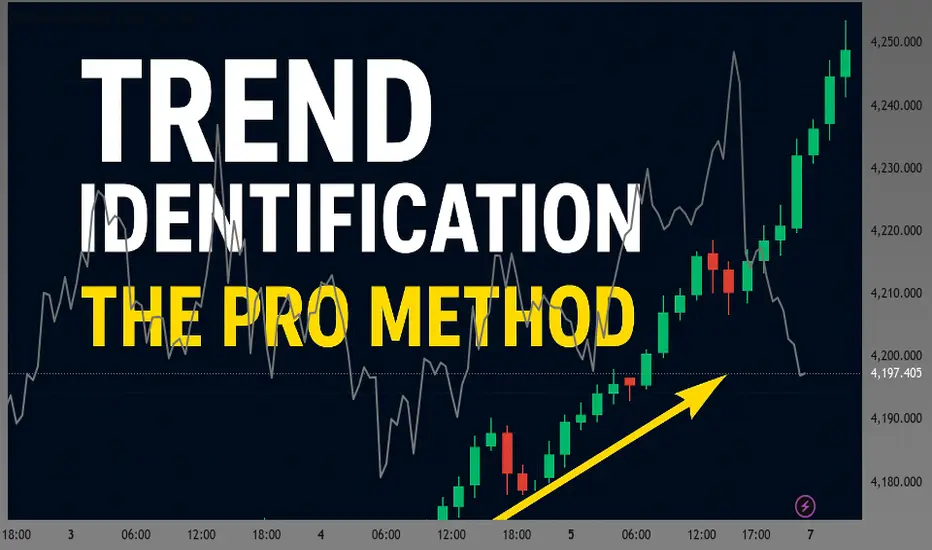
The Foundation of Every Winning Trading Strategy
Identifying the trend is the most important skill a trader can develop. Almost every successful strategy — breakouts, pullbacks, SMC, swing trading, scalping — depends on knowing whether the market is trending or ranging. In this educational idea, you’ll learn how professionals detect the trend using clean, simple price-action rules that work on every timeframe and every market.
---
🔹 Why Trend Identification Matters
Most losing trades happen because traders enter against the trend.
A strong bullish or bearish trend makes:
- Breakouts more reliable
- Pullbacks cleaner
- Targets larger
- Reversals less frequent
When you follow the trend, your trades have a natural advantage.
---
🔹 Step 1: Understand Market Structure (HH, HL, LH, LL)
The trend is defined by swing structure, not indicators.
Bullish Trend Structure
- Higher High (HH)
- Higher Low (HL)
- New Higher High (HH)
This shows buyers are in control.
Bearish Trend Structure
- Lower Low (LL)
- Lower High (LH)
- New Lower Low (LL)
This shows sellers dominate.
If structure is unclear, the market is likely ranging, not trending.
---
🔹 Step 2: Use the “Three-Push Rule”
A simple rule:
If you see three consecutive HH + HL, the trend is confirmed bullish.
If you see three consecutive LL + LH, the trend is confirmed bearish.
This rule filters out fake short-term moves.
---
🔹 Step 3: Identify Trend Strength Using Candle Behavior
Trend strength shows in the candles:
Strong Bullish Trend Candles
- Large green bodies
- Small or no lower wicks
- Fast recovery after pullbacks
Strong Bearish Trend Candles
- Large red bodies
- Small or no upper wicks
- Sharp drops after minor retracements
Candle behavior tells you confidence and momentum.
---
🔹 Step 4: Check Pullbacks for Confirmation
Pullbacks are the heart of trend trading.
Bullish Pullback Confirmation
- Slow downward correction
- Decreasing candle size
- Tap into demand or previous structure
- Powerful bullish continuation candle
Bearish Pullback Confirmation
- Slow upward correction
- Weak bullish candles
- Tap into supply zone
- Strong bearish continuation candle
The nature of pullbacks reveals trend quality.
---
🔹 Step 5: Use Dynamic Support & Resistance (Trendlines)
Trendlines help visualize the trend direction:
- Uptrend → connect lows
- Downtrend → connect highs
If price respects the trendline multiple times, the trend is strong.
But remember:
Trendlines support your analysis, they don’t replace market structure.
---
🔹 Step 6: Multi-Timeframe Trend Alignment (MTF)
Professional traders follow the higher timeframe trend.
Example for Gold (XAUUSD):
- Daily trend: Bullish
- 4H trend: Bullish
- 1H trend: Bullish
Now you take only buys on 15m or 5m.
This increases accuracy dramatically.
If higher timeframes disagree, expect:
- Choppiness
- Ranges
- Unknown direction
MTF alignment = cleaner trades.
---
🔹 Step 7: Spot Trend Reversals Early
Reversals happen after clear signals:
Bullish → Bearish Reversal
- Failure to create new HH
- Break of previous HL (structure break)
- Formation of LH
- Shift of order flow
Bearish → Bullish Reversal
- Failure to create new LL
- Break of previous LH
- Formation of HL
- Bullish BOS (Break of Structure)
Structure tells you when the trend has officially changed.
---
🔥 Final Professional Tip
Do not fight the trend.
A trend can stay strong longer than traders expect.
Use:
- Structure
- Pullbacks
- Trendlines
- Multi-timeframe alignment
- Momentum candles
Combine these methods and you’ll identify trends with clarity and confidence — just like professional traders.
Your boosts, comments, and likes motivate me to share more accurate analyses like this.
👉 If you found this helpful, please Boost the idea and leave a comment — it really helps!
— JT_CHARTsMaster
Identifying the trend is the most important skill a trader can develop. Almost every successful strategy — breakouts, pullbacks, SMC, swing trading, scalping — depends on knowing whether the market is trending or ranging. In this educational idea, you’ll learn how professionals detect the trend using clean, simple price-action rules that work on every timeframe and every market.
---
🔹 Why Trend Identification Matters
Most losing trades happen because traders enter against the trend.
A strong bullish or bearish trend makes:
- Breakouts more reliable
- Pullbacks cleaner
- Targets larger
- Reversals less frequent
When you follow the trend, your trades have a natural advantage.
---
🔹 Step 1: Understand Market Structure (HH, HL, LH, LL)
The trend is defined by swing structure, not indicators.
Bullish Trend Structure
- Higher High (HH)
- Higher Low (HL)
- New Higher High (HH)
This shows buyers are in control.
Bearish Trend Structure
- Lower Low (LL)
- Lower High (LH)
- New Lower Low (LL)
This shows sellers dominate.
If structure is unclear, the market is likely ranging, not trending.
---
🔹 Step 2: Use the “Three-Push Rule”
A simple rule:
If you see three consecutive HH + HL, the trend is confirmed bullish.
If you see three consecutive LL + LH, the trend is confirmed bearish.
This rule filters out fake short-term moves.
---
🔹 Step 3: Identify Trend Strength Using Candle Behavior
Trend strength shows in the candles:
Strong Bullish Trend Candles
- Large green bodies
- Small or no lower wicks
- Fast recovery after pullbacks
Strong Bearish Trend Candles
- Large red bodies
- Small or no upper wicks
- Sharp drops after minor retracements
Candle behavior tells you confidence and momentum.
---
🔹 Step 4: Check Pullbacks for Confirmation
Pullbacks are the heart of trend trading.
Bullish Pullback Confirmation
- Slow downward correction
- Decreasing candle size
- Tap into demand or previous structure
- Powerful bullish continuation candle
Bearish Pullback Confirmation
- Slow upward correction
- Weak bullish candles
- Tap into supply zone
- Strong bearish continuation candle
The nature of pullbacks reveals trend quality.
---
🔹 Step 5: Use Dynamic Support & Resistance (Trendlines)
Trendlines help visualize the trend direction:
- Uptrend → connect lows
- Downtrend → connect highs
If price respects the trendline multiple times, the trend is strong.
But remember:
Trendlines support your analysis, they don’t replace market structure.
---
🔹 Step 6: Multi-Timeframe Trend Alignment (MTF)
Professional traders follow the higher timeframe trend.
Example for Gold (XAUUSD):
- Daily trend: Bullish
- 4H trend: Bullish
- 1H trend: Bullish
Now you take only buys on 15m or 5m.
This increases accuracy dramatically.
If higher timeframes disagree, expect:
- Choppiness
- Ranges
- Unknown direction
MTF alignment = cleaner trades.
---
🔹 Step 7: Spot Trend Reversals Early
Reversals happen after clear signals:
Bullish → Bearish Reversal
- Failure to create new HH
- Break of previous HL (structure break)
- Formation of LH
- Shift of order flow
Bearish → Bullish Reversal
- Failure to create new LL
- Break of previous LH
- Formation of HL
- Bullish BOS (Break of Structure)
Structure tells you when the trend has officially changed.
---
🔥 Final Professional Tip
Do not fight the trend.
A trend can stay strong longer than traders expect.
Use:
- Structure
- Pullbacks
- Trendlines
- Multi-timeframe alignment
- Momentum candles
Combine these methods and you’ll identify trends with clarity and confidence — just like professional traders.
Your boosts, comments, and likes motivate me to share more accurate analyses like this.
👉 If you found this helpful, please Boost the idea and leave a comment — it really helps!
— JT_CHARTsMaster

→ Accurate Gold Setups
→ Market Structure | SMCs | Trend & Breakout Analysis
→ Join My Channel 👇
t.me/+MqtqMxC9fe02OTJk
→ For Support 👇
t.me/LegendaryZayan
→ Recommended Broker 👇
vigco.co/la-com/D6QxKb1s
→ Market Structure | SMCs | Trend & Breakout Analysis
→ Join My Channel 👇
t.me/+MqtqMxC9fe02OTJk
→ For Support 👇
t.me/LegendaryZayan
→ Recommended Broker 👇
vigco.co/la-com/D6QxKb1s
Publikasi terkait
Pernyataan Penyangkalan
Informasi dan publikasi ini tidak dimaksudkan, dan bukan merupakan, saran atau rekomendasi keuangan, investasi, trading, atau jenis lainnya yang diberikan atau didukung oleh TradingView. Baca selengkapnya di Ketentuan Penggunaan.
→ Accurate Gold Setups
→ Market Structure | SMCs | Trend & Breakout Analysis
→ Join My Channel 👇
t.me/+MqtqMxC9fe02OTJk
→ For Support 👇
t.me/LegendaryZayan
→ Recommended Broker 👇
vigco.co/la-com/D6QxKb1s
→ Market Structure | SMCs | Trend & Breakout Analysis
→ Join My Channel 👇
t.me/+MqtqMxC9fe02OTJk
→ For Support 👇
t.me/LegendaryZayan
→ Recommended Broker 👇
vigco.co/la-com/D6QxKb1s
Publikasi terkait
Pernyataan Penyangkalan
Informasi dan publikasi ini tidak dimaksudkan, dan bukan merupakan, saran atau rekomendasi keuangan, investasi, trading, atau jenis lainnya yang diberikan atau didukung oleh TradingView. Baca selengkapnya di Ketentuan Penggunaan.